Mathematics: A Catalyst for Prosperity and Sustainable Innovation
- Thời gian
- : 15:30 10/09/2025
- Địa điểm
- : University Hall, 7th floor, T5, VNU University of Science, Hanoi
- Đại biểu tham dự
- : Public lecture by Wil Schilders, president of the
International Council for Industrial and Applied Mathematics
Nội dung:
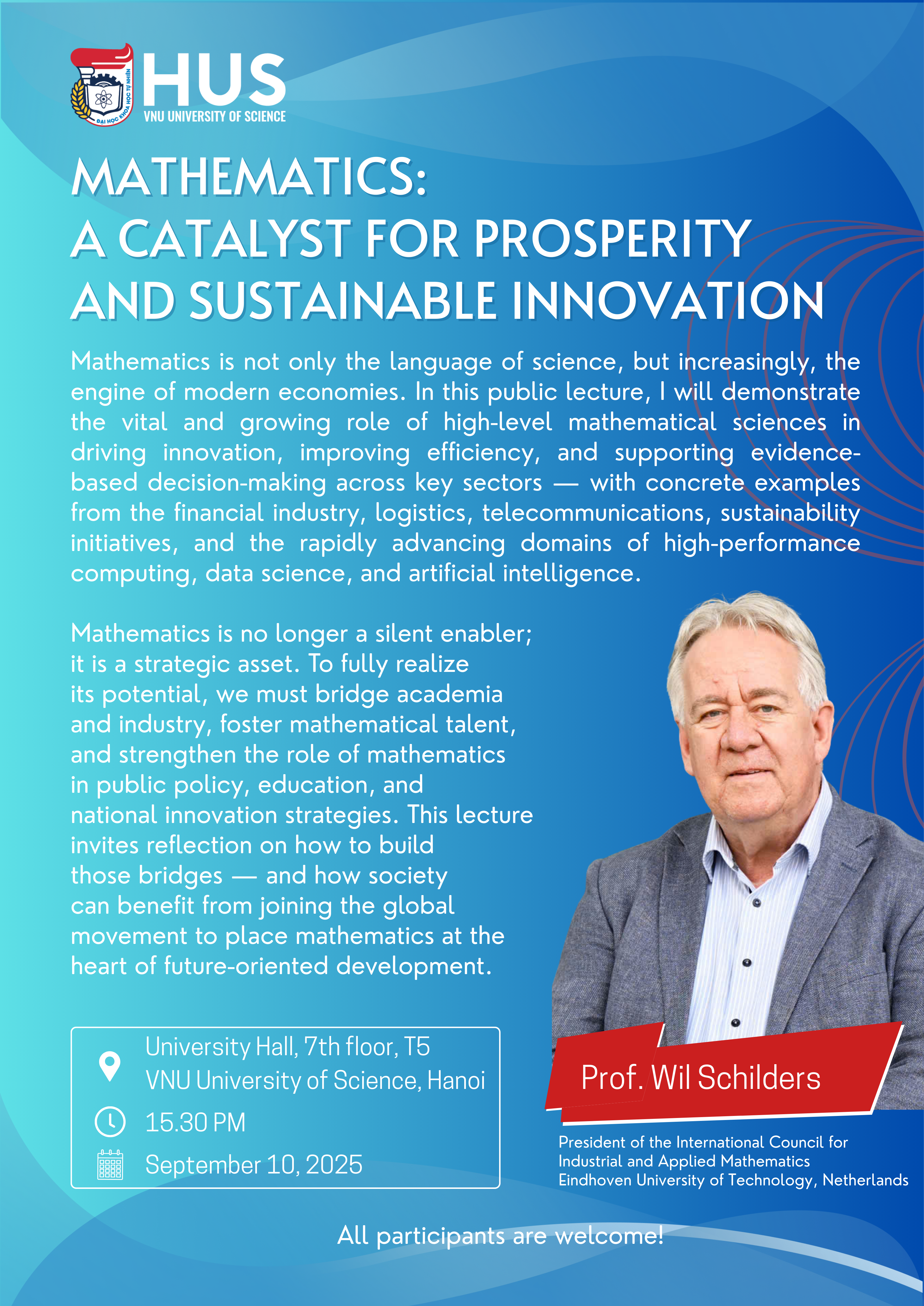
 Mathematics: A Catalyst for Prosperity and Sustainable Innovation
=============================
 Public lecture by Wil Schilders, president of the
International Council for Industrial and Applied Mathematics
=============================
Mathematics is not only the language of science, but increasingly, the engine of modern economies. In this public lecture, I will demonstrate the vital and growing role of high-level mathematical sciences in driving innovation, improving efficiency, and supporting evidence-based decision-making across key sectors — with concrete examples from the financial industry, logistics, telecommunications, sustainability initiatives, and the rapidly advancing domains of high-performance computing, data science, and artificial intelligence.
The economic impact of mathematics is profound. Recent studies in the United Kingdom, France, the Netherlands, and the United States have revealed that between 9% and 16% of national GDP is directly attributable to mathematically intensive activities. In the UK alone, mathematics-supported sectors contributed £208 billion in GVA, representing 10% of all employment and 16% of GVA. Similar figures apply to France, where mathematics accounts for 15% of GDP and 9% of jobs, including some of the most productive and fastest-growing sectors such as IT services, energy, finance, and R&D. In the Netherlands, mathematical sciences support 26% of employment and 30% of national income, showing the compound impact when direct, indirect, and induced effects are considered.
In financial services, advanced mathematics underpins risk modelling, portfolio optimization, algorithmic trading, and fraud detection. Mathematical models are fundamental to developing CVA/DVA adjustments, market risk analysis, and fraud detection systems using anomaly detection and Bayesian inference.
In logistics, mathematics enables the real-time optimization of complex distribution networks and transport systems. Companies such as PostNL and Schiphol Airport in The Netherlands depend on queuing theory, combinatorics, and network flow models to improve service reliability and reduce operational costs.
In telecommunications, mathematics is the invisible backbone of signal processing, bandwidth allocation, and data integrity across digital communication networks, including the rollout of 5G and future 6G systems.
Mathematics is also indispensable in the quest for sustainability. It enables the modelling of climate dynamics, the optimization of renewable energy systems, and the development of resilient infrastructure. For example, mathematical modelling led to a redesign of dike height standards in the Netherlands, saving €4.3 billion while increasing flood safety.
Crucially, mathematics lies at the heart of high-performance computing (HPC) and computational science and engineering (CSE). It is important to recognize that mathematical method development has consistently outpaced machine improvements, and has done so for decades. From numerical linear algebra to multi-scale and uncertainty quantification techniques, advances in mathematical algorithms have driven the performance gains in simulation, modeming, and data-intensive computing — far more than hardware evolution alone.
In data science, mathematics provides the analytical core of everything from predictive modelling and statistical inference to dimensionality reduction and optimal decision-making under uncertainty. The future of trustworthy data science depends on a solid mathematical foundation. In artificial intelligence, mathematics is both the foundation and the conscience of the field. It ensures that algorithms are interpretable, robust, and trustworthy. And while AI systems grow more powerful, their reliability and fairness will depend on deeper mathematical insight. As such, it is no exaggeration to say: Real intelligence is needed to make artificial intelligence work.
Mathematics is no longer a silent enabler; it is a strategic asset. To fully realize its potential, we must bridge academia and industry, foster mathematical talent, and strengthen the role of mathematics in public policy, education, and national innovation strategies. This lecture invites reflection on how to build those bridges — and how society can benefit from joining the global movement to place mathematics at the heart of future-oriented development.
Liên hệ
- Họ và tên
- :
- E-Mail
- :
- Điện thoại
- :
- Địa chỉ liên hệ
- :